
Choosing a name is one of the most meaningful decisions a person can make. Whether you’re creating a fictional character, researching family history, writing a novel, exploring Russian culture, building a gaming identity, or simply satisfying your curiosity, surnames carry stories that stretch across generations.
Russian surnames are especially fascinating because they often reveal family origins, occupations, personal traits, geography, and even social history. Unlike many modern naming systems that focus primarily on identification, traditional Russian family names frequently preserve pieces of the past. A single surname can hint at what an ancestor did for a living, where they lived, or which qualities were admired in the family.
In this comprehensive guide, you’ll discover the history behind Russian family names, learn how they are formed, explore popular and unique options, and find inspiration from traditional, modern, strong, elegant, and rare surname styles.
Quick Guide: Which Type of Russian Last Name Are You Looking For?
Before diving deeper, identify the category that best matches your goal.
If You’re Looking for Traditional Family Names
Explore classic surnames that have existed for centuries and remain common throughout Russia today.
If You’re Creating a Character
Consider surnames that match personality, social status, profession, region, or historical period.
If You Want Something Unique
Look for rare, uncommon, and regional family names that stand out from the crowd.
If You Prefer Elegant or Sophisticated Names
Focus on aristocratic-sounding and refined surname styles.
If You Want Strong and Powerful Names
Choose surnames associated with nature, strength, military history, or respected family lineages.
If You’re Researching Heritage
Understanding surname meanings and origins can provide clues about ancestral roots and family history.
Understanding Russian Last Names
Russian surnames are known as “familiya” and are typically inherited through family lines. Most modern Russian naming structures include:
- First name
- Patronymic (derived from the father’s first name)
- Family surname
For example:
Ivan Petrovich Smirnov
- Ivan = first name
- Petrovich = son of Petr
- Smirnov = family surname
This structure creates a strong connection between personal identity and family heritage.
What Makes a Good Russian Surname?
The best surname depends on your purpose.
A strong family name often has:
Historical Depth
Names with genuine roots feel authentic and believable.
Easy Pronunciation
If you’re using the name internationally, simplicity can improve memorability.
Cultural Accuracy
Writers and creators benefit from choosing surnames appropriate to the character’s region and background.
Personality Alignment
Some names sound noble, while others feel rugged, intellectual, artistic, or mysterious.
Distinctiveness
Rare surnames help individuals and fictional characters stand apart.
The psychology behind naming suggests that people often form impressions based solely on how a name sounds. Strong consonants may convey authority, while softer sounds often feel approachable or elegant.
How Russian Surnames Originated
Many Russian family names developed from several common sources.
Occupational Origins
These surnames came from jobs or trades.
Examples include:
- Kuznetsov – blacksmith
- Plotnikov – carpenter
- Melnikov – miller
- Goncharov – potter
- Rybakov – fisherman
Occupational surnames helped communities identify families by their work.
Patronymic Origins
Many surnames originated from a father’s given name.
Examples:
- Ivanov – son or descendant of Ivan
- Petrov – descendant of Petr
- Sergeev – descendant of Sergei
- Nikolaev – descendant of Nikolai
These remain among the most widespread Russian family names today.
Nature-Inspired Origins
Russia’s vast landscapes influenced many family names.
Examples:
- Sokolov – falcon
- Lebedev – swan
- Volkov – wolf
- Medvedev – bear
- Orlov – eagle
Animal-based surnames often symbolized admired traits such as courage, intelligence, or loyalty.
Geographic Origins
Some surnames reflect locations or regional identities.
Examples:
- Moskovsky
- Karelin
- Sibiryakov
- Volzhin
These names may indicate where a family once lived or originated.
Most Popular Russian Last Names
Certain surnames have become deeply associated with Russian culture.
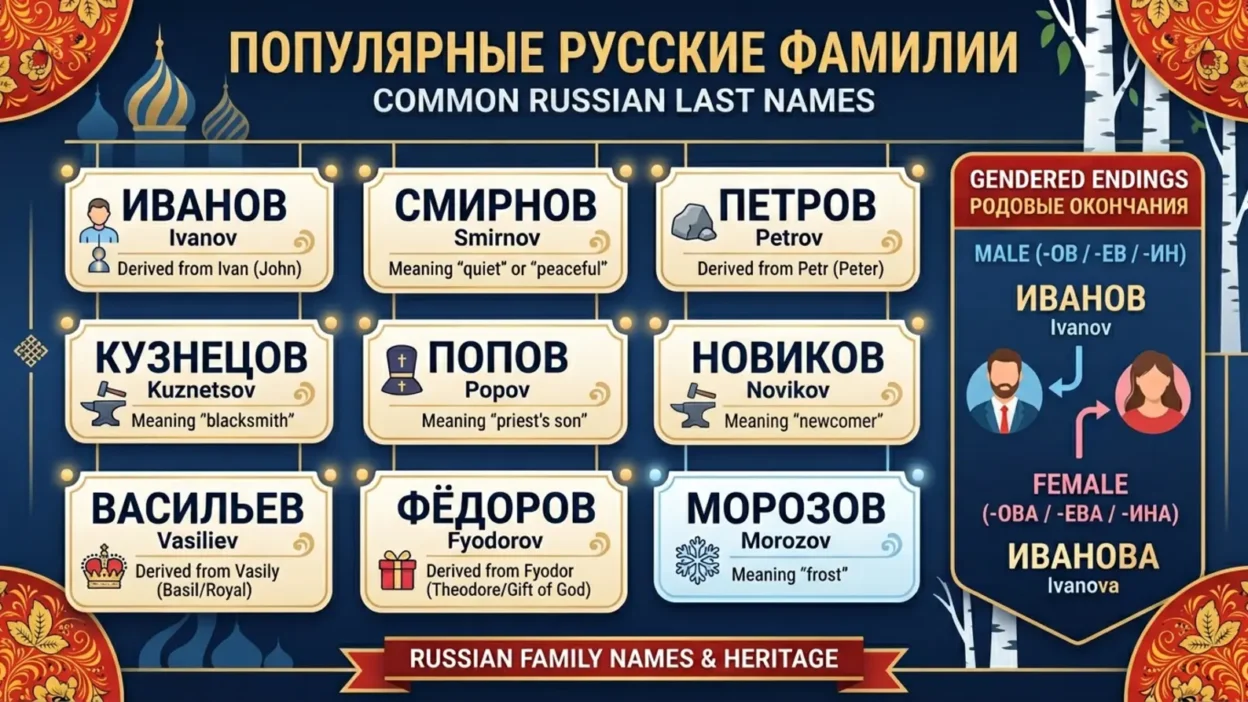
Ivanov
One of the most recognizable Russian family names. Derived from Ivan, it carries centuries of historical usage.
Smirnov
Often linked to the word meaning peaceful or calm.
Kuznetsov
Connected to blacksmithing traditions.
Popov
Historically associated with clergy families.
Sokolov
Inspired by the falcon, symbolizing speed and nobility.
Petrov
Derived from the given name Petr.
Volkov
Meaning wolf, associated with resilience and strength.
Lebedev
Inspired by the graceful swan.
Kozlov
Derived from the Russian word for goat.
Novikov
Historically linked to newcomers or new settlers.
These names remain among the most recognized Russian surnames worldwide.
Strong and Powerful Russian Surnames
Many people seek names that project confidence, leadership, and determination.
Popular powerful choices include:
- Volkov
- Medvedev
- Orlov
- Sokolov
- Bogatyrev
- Gromov
- Morozov
- Vasiliev
- Romanov
- Dragunov
Why they work:
These surnames often draw from animals, natural forces, historical warriors, or respected family traditions. They communicate strength without sounding exaggerated.
Elegant and Sophisticated Russian Last Names
Some surnames carry an aristocratic or refined quality.
Examples include:
- Romanov
- Obolensky
- Dolgorukov
- Vorontsov
- Golitsyn
- Sheremetev
- Trubetskoy
- Yusupov
- Demidov
- Rostov
These names are frequently associated with nobility, literature, history, and cultural influence.
They work particularly well for:
- Historical fiction
- Luxury branding
- Sophisticated character creation
- Artistic projects
Unique Russian Last Names
If your goal is originality, consider lesser-known family names.
Examples:
- Zvezdin
- Svetlov
- Yarov
- Belozersky
- Tsvetkov
- Kamenev
- Zorin
- Vetrov
- Solovyov
- Zolotarev
Unique surnames help create memorable identities while maintaining cultural authenticity.
Rare Russian Surnames
Rare names often attract attention because they sound fresh and distinctive.
Examples:
- Nebesny
- Rassvetov
- Mirovsky
- Berezkin
- Gromadin
- Chernetsky
- Zlatov
- Lesnikov
- Vetrogradov
- Severinov
These surnames are excellent for writers, gamers, role-playing enthusiasts, and world-building projects.
Aesthetic Russian Last Names
Some surnames simply sound beautiful.
Popular aesthetic options include:
- Solovyov
- Lebedev
- Svetlov
- Tsvetkov
- Belinsky
- Zorin
- Vesnin
- Zvezdin
- Mironov
- Almazov
Their appeal often comes from smooth pronunciation and positive imagery.
Many evoke:
- Flowers
- Light
- Stars
- Harmony
- Nature
Russian Last Names Inspired by Animals
Animals play a major role in Slavic naming traditions.
Wolf-Inspired
- Volkov
Bear-Inspired
- Medvedev
Eagle-Inspired
- Orlov
Falcon-Inspired
- Sokolov
Swan-Inspired
- Lebedev
Fox-Inspired
- Lisitsyn
Hawk-Inspired
- Yastrebov
Dove-Inspired
- Golubev
Animal surnames often symbolize admired qualities and remain highly popular.
Nature-Inspired Russian Family Names
Nature continues to inspire beautiful surname choices.
Examples include:
Forest-Inspired
- Lesnikov
- Berezkin
Winter-Inspired
- Morozov
River-Inspired
- Volzhin
Sky-Inspired
- Nebesov
Wind-Inspired
- Vetrov
Flower-Inspired
- Tsvetkov
Mountain-Inspired
- Gorsky
These names create vivid imagery and emotional resonance.
Creative and Artistic Russian Surnames
Creative personalities often gravitate toward names that feel expressive.
Examples:
- Svetlov
- Zvezdin
- Almazov
- Solovyov
- Mirov
- Vetrov
- Belinsky
- Yarin
- Severov
- Zolotov
These surnames sound imaginative and memorable without losing authenticity.
Russian Last Names for Fictional Characters
Character naming requires balancing realism and personality.
Heroic Characters
- Volkov
- Sokolov
- Romanov
- Orlov
- Bogatyrev
Villains
- Morozov
- Dragunov
- Karpov
- Chernov
- Vasiliev
Intellectual Characters
- Belinsky
- Smirnov
- Antonov
- Mirov
- Pavlov
Mysterious Characters
- Vetrov
- Severov
- Nebesny
- Zorin
- Yarov
The best fictional surnames subtly reinforce a character’s role and personality.
Russian Last Names for Writers and Creators
Authors often seek names that readers can remember.
Good choices include:
- Romanov
- Zorin
- Vetrov
- Sokolov
- Belinsky
- Mirov
- Orlov
- Svetlov
- Tsvetkov
- Lebedev
These names balance uniqueness and readability.
Modern Trends in Russian Surname Preferences (2026)
Current naming trends reveal growing interest in:
Heritage-Based Choices
People increasingly value names connected to ancestry and cultural identity.
Shorter Surnames
Compact surnames are becoming more attractive for digital platforms and international use.
Examples:
- Orlov
- Zorin
- Yarov
- Volkov
Nature-Themed Names
Names associated with animals, seasons, and landscapes continue gaining popularity.
Noble and Historical Styles
Historic surnames maintain strong appeal because they convey prestige and tradition.
International Compatibility
Many people prefer surnames that are easy to pronounce across languages and cultures.
Russian Surname Endings and What They Mean
Understanding common endings helps decode family names.
-ov / -ev
Examples:
- Ivanov
- Petrov
- Medvedev
Usually indicates descent or family association.
-in
Examples:
- Pushkin
- Ilyin
Often derived from personal names.
-sky / -skiy
Examples:
- Belinsky
- Obolensky
Frequently associated with places or noble families.
-ko
Found more commonly in neighboring Slavic regions but sometimes appears in Russian contexts.
-ovich
Often appears in patronymics and occasionally influences surname formation.
Recognizing these patterns helps identify a surname’s historical roots.
How to Choose the Right Russian Last Name
If you’re selecting a surname for a project or personal use, consider these steps.
Step 1: Define the Purpose
Ask yourself:
- Character creation?
- Genealogy research?
- Pen name?
- Gaming identity?
- Creative brand?
Purpose influences the ideal style.
Step 2: Match Personality
Choose names reflecting desired traits.
For strength:
- Volkov
- Orlov
For elegance:
- Romanov
- Golitsyn
For creativity:
- Svetlov
- Vetrov
Step 3: Consider Pronunciation
If international audiences will encounter the name, simplicity matters.
Examples:
- Ivanov
- Petrov
- Romanov
- Orlov
These are easy for many language speakers to pronounce.
Step 4: Test Memorability
Read the surname aloud.
Ask:
- Is it easy to remember?
- Does it fit the intended image?
- Does it sound authentic?
A memorable surname creates stronger emotional connections.
Step 5: Check Cultural Consistency
For writers especially, ensure the surname aligns with the character’s location, age, social background, and historical period.
Authenticity improves immersion.
Common Mistakes When Choosing Russian Surnames
Avoid these frequent errors.
Choosing Purely for Appearance
A beautiful surname should also fit the context.
Ignoring Meaning
Many names carry symbolism that may conflict with intended usage.
Overcomplicating Pronunciation
Extremely difficult names can frustrate readers or audiences.
Mixing Incompatible Styles
Historical, regional, and modern naming conventions should align logically.
Using Stereotypes
Authentic naming feels more believable than exaggerated clichés.
Frequently Asked Questions About Russian Last Names
What is the most common Russian surname?
Ivanov is widely recognized as one of the most common family names in Russia.
Why do many Russian surnames end in -ov?
The ending traditionally indicates family connection or descent from a particular ancestor.
Are Russian surnames gendered?
Yes. Many surnames have masculine and feminine forms. For example, Ivanov becomes Ivanova for women.
What do Russian surnames usually mean?
They often derive from occupations, ancestors’ names, animals, locations, personality traits, or natural features.
Are noble Russian surnames still used today?
Yes. Many historical aristocratic family names continue to exist and are recognized throughout the world.
Which Russian surnames sound strongest?
Volkov, Medvedev, Orlov, Romanov, and Bogatyrev are frequently perceived as strong and authoritative.
What are good Russian surnames for fictional characters?
Popular options include Volkov, Sokolov, Vetrov, Zorin, Romanov, and Morozov because they are memorable and culturally authentic.
What is the difference between a patronymic and a surname?
A patronymic identifies a person’s father, while a surname identifies the family line.
Are animal-based surnames common in Russia?
Yes. Wolf, eagle, falcon, swan, and bear-inspired surnames are deeply rooted in Russian naming traditions.
Can Russian surnames be used as pen names?
Absolutely. Many writers, artists, and creators choose Russian-style surnames because they sound distinctive and memorable.
Final Thoughts
A surname is more than a label. It carries history, personality, identity, and meaning. Russian family names are especially rich because they connect people to centuries of culture, tradition, nature, and ancestry.
Whether you’re searching for a powerful surname like Volkov, an elegant option such as Romanov, a nature-inspired choice like Vetrov, or a rare and distinctive family name that stands apart, the best choice is the one that creates a genuine connection.
Names shape first impressions, tell stories without words, and help define how people see themselves and others. Take time to explore meanings, sounds, and cultural backgrounds. The right surname doesn’t simply identify a person or character—it gives them a lasting identity.
As you continue your search, trust both research and intuition. The most memorable names are often the ones that feel immediately right while carrying a story worth telling.


