
Choosing a surname is more meaningful than many people realize. Whether you’re writing a novel, creating a fictional family, researching your ancestry, building a gaming identity, naming a business character, or simply fascinated by German heritage, the right last name can instantly communicate history, personality, culture, and identity.
German family names are among the oldest and most recognizable surnames in Europe. Some originated from occupations, while others came from geography, personal characteristics, noble lineages, or even ancient Germanic words that have survived for centuries. Today, these surnames are found not only throughout Germany but also in Austria, Switzerland, the United States, Canada, Brazil, Australia, and many other countries where German immigrants settled.
This guide brings together hundreds of authentic German surnames, explains where they come from, explores what makes a memorable family name, and helps you choose one that fits your specific purpose. Whether you’re searching for something traditional, elegant, rare, powerful, modern, or uniquely meaningful, you’ll find inspiration throughout this comprehensive collection.
Find the Right German Last Name for Your Situation
Not everyone is looking for the same type of surname. Start with the category that best matches your goal.
If you’re researching family history
Look for traditional occupational names, regional surnames, and ancient German family names that have been passed down for generations.
If you’re writing fiction
Unique, noble, medieval, or rare surnames often create memorable characters while adding historical authenticity.
If you’re creating a gaming username
Short, bold, and strong surnames work especially well for fantasy, action, and competitive games.
If you’re choosing a pen name
Elegant, timeless, or sophisticated German surnames tend to feel professional while remaining memorable.
If you’re naming a fictional family
Classic multi-generational surnames with historical roots help create believable family backgrounds.
If you simply love languages and names
Explore the meanings behind German surnames to discover fascinating connections between history, geography, occupations, and identity.
Why German Last Names Continue to Fascinate People
A surname is more than a label. It tells a story.
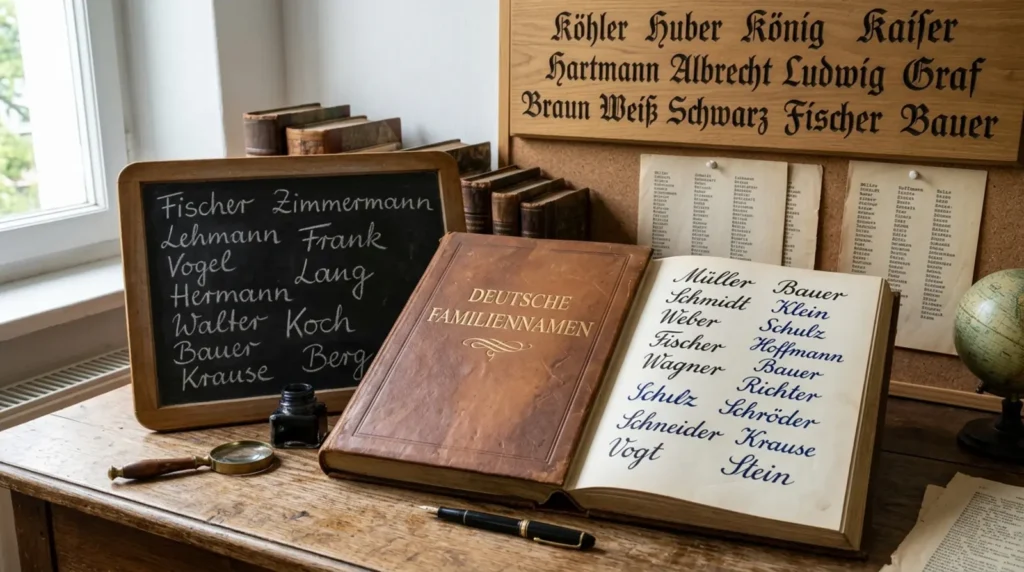
Many German family names reveal what someone’s ancestors did for a living, where they lived, what they looked like, or even what kind of personality they were known for. Unlike randomly invented names, traditional German surnames often carry centuries of history.
For example, families might have adopted surnames based on:
- Their profession
- Their hometown
- Nearby forests, rivers, or mountains
- Physical appearance
- Personality traits
- Noble ancestry
- Religious traditions
- Household responsibilities
- Military service
- Local dialects
Because of these rich origins, German surnames often feel authentic, distinctive, and meaningful.
What Makes a Great German Last Name?
The best surname depends entirely on how you plan to use it, but several qualities consistently make certain names stand out.
Authenticity
Real German surnames have linguistic patterns that immediately sound believable. Many include endings like:
- -mann
- -berg
- -stein
- -bach
- -wald
- -dorf
- -meier
- -schmidt
- -hoff
- -thal
These endings instantly communicate German heritage while maintaining historical accuracy.
Easy Pronunciation
Even if you’re choosing a traditional surname, readability matters. A name that’s easy to pronounce is easier to remember and more likely to leave a lasting impression.
Meaning
Names connected to strength, wisdom, nature, craftsmanship, or leadership often resonate more deeply because they evoke positive associations.
Timeless Appeal
Some surnames have remained popular for centuries because they balance simplicity with elegance. They never feel outdated.
Understanding the Origins of German Surnames
German surnames generally fall into several historical categories.
Occupational Surnames
These originated from a person’s profession.
Examples include:
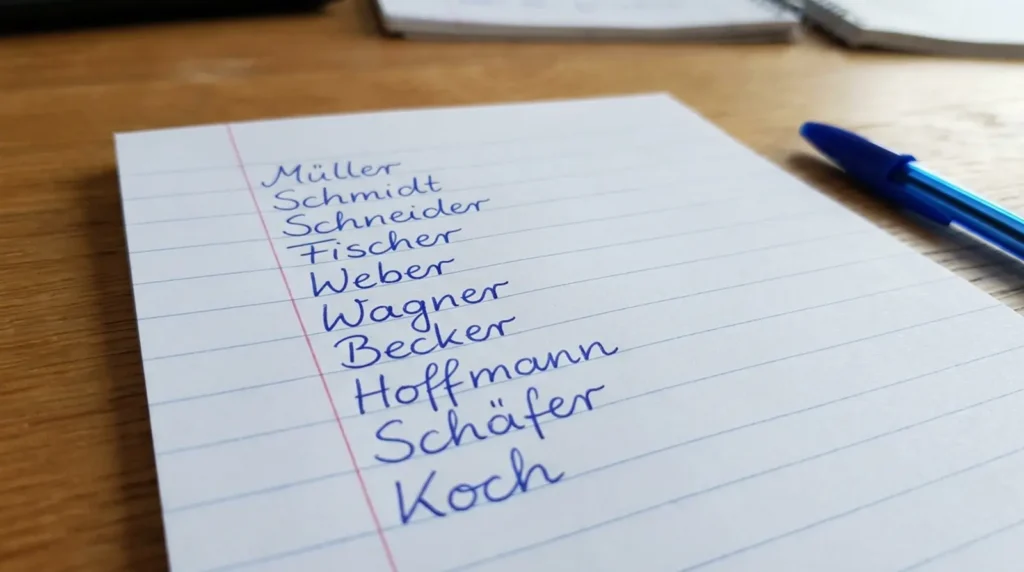
- Schmidt — Blacksmith
- Müller — Miller
- Fischer — Fisherman
- Wagner — Wagon maker
- Becker — Baker
- Schneider — Tailor
- Weber — Weaver
- Zimmermann — Carpenter
- Schäfer — Shepherd
- Koch — Cook
Occupational names remain some of the most recognizable German surnames worldwide.
Geographic Surnames
Many families took names from the places where they lived.
These might reference:
- Mountains
- Rivers
- Forests
- Villages
- Valleys
- Castles
- Meadows
Examples include:
- Berg
- Bach
- Wald
- Tal
- Kirchberg
- Rosenberg
- Steinbach
- Lindenberg
- Grünwald
- Eisenberg
These names often create vivid imagery while preserving local history.
Descriptive Surnames
Some surnames reflected a person’s appearance or personality.
Examples include names associated with:
- Tallness
- Hair color
- Bravery
- Intelligence
- Cheerfulness
- Kindness
- Speed
- Strength
These names helped distinguish people within growing medieval communities.
Patronymic Origins
Certain surnames originated from a father’s given name.
Examples include families descended from:
- Heinrich
- Johann
- Peter
- Martin
- Wilhelm
Over time, these evolved into permanent family names.
Most Popular German Last Names
These surnames have remained common across generations and continue to appear throughout Germany and German-speaking communities around the world.
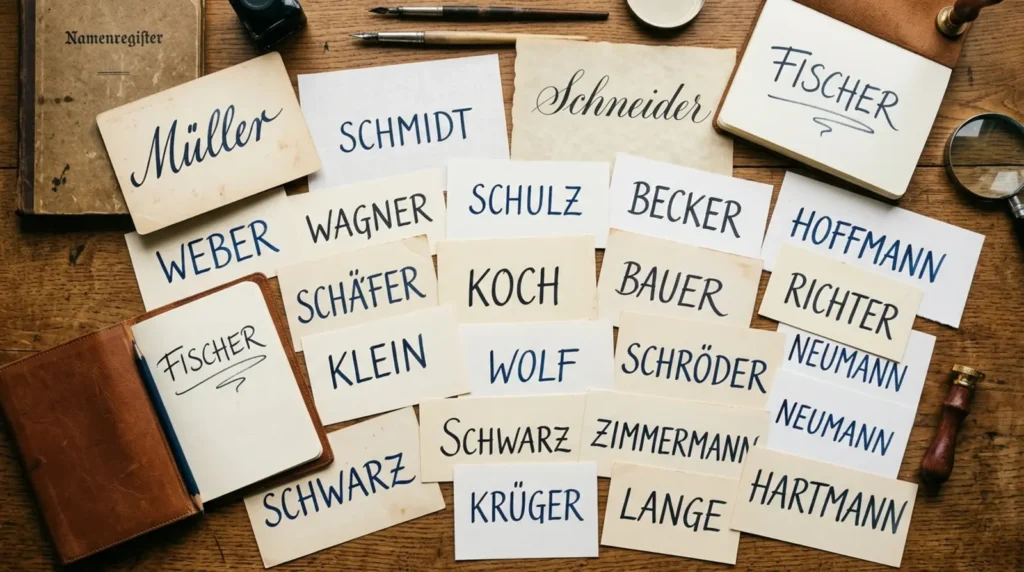
- Müller
- Schmidt
- Schneider
- Fischer
- Weber
- Meyer
- Wagner
- Becker
- Hoffmann
- Schulz
- Koch
- Richter
- Klein
- Wolf
- Schröder
- Neumann
- Schwarz
- Braun
- Zimmermann
- Krüger
- Hofmann
- Hartmann
- Lange
- Werner
- Krause
- Lehmann
- Schmitt
- Schulze
- Maier
- Hermann
- Franke
- Peters
- Albrecht
- Kaiser
- Busch
- Sommer
- Otto
- Arnold
- Conrad
- Heinrich
These surnames have remained popular because they combine historical significance with clear pronunciation and strong cultural recognition.
Classic German Last Names That Never Go Out of Style
Some family names possess an enduring elegance that works equally well in history books, novels, modern storytelling, and genealogy.
- Adler
- Bauer
- Brandt
- Engel
- Falk
- Frey
- Grimm
- Günther
- Hartwig
- Heinemann
- Jäger
- Keller
- König
- Lorenz
- Maurer
- Nickel
- Pfeiffer
- Rieger
- Sauer
- Vogel
- Winter
- Ziegler
- Ulrich
- Reuter
- Seidel
- Thiel
- Urban
- Vogt
- Weiß
- Winterfeld
These surnames strike an excellent balance between familiarity and sophistication.
Strong German Last Names
If you’re looking for a surname that conveys confidence, resilience, or authority, these names have a naturally powerful sound.
- Eisen
- Eisenmann
- Stahl
- Stark
- Donner
- König
- Adler
- Falken
- Wolfhart
- Krieger
- Hammer
- Schild
- Brand
- Sturm
- Falkenberg
- Eisenberg
- Ritter
- Löwe
- Hartmann
- Stein
- Schwert
- Winterstein
- Burgmann
- Herzog
- Graf
- Greif
- Thorwald
- Hagen
- Falkner
- Kraft
These surnames are especially popular for fictional heroes, fantasy worlds, gaming identities, and historical characters because they evoke strength without sounding exaggerated.
Elegant and Sophisticated German Family Names
For authors, professionals, and anyone seeking a refined surname, these names carry a graceful, distinguished quality.
- Rosenberg
- Linden
- Morgenstern
- Silbermann
- Goldmann
- Himmel
- Rosenthal
- Falkenberg
- Winterberg
- Sommerfeld
- Blum
- Edelmann
- Kirchhoff
- Sternberg
- Kronenberg
- Hochberg
- Sonnenfeld
- Eichenwald
- Bernstein
- Tannenberg
- Weißberg
- Silberstein
- Bergmann
- Ehrenfeld
- Vogelmann
- Lindenhof
- Eberhardt
- Hohenberg
- Falkenthal
- Rosenfeld
These names blend historical authenticity with an elegant rhythm, making them excellent choices for novels, professional pen names, or sophisticated fictional families.
Rare German Last Names
Not every German surname is seen every day. Some family names have become uncommon over the centuries due to migration, changing spellings, or smaller family lines. Rare surnames often feel distinctive while still maintaining authentic German roots, making them ideal for writers, genealogists, and anyone looking for a memorable name.
- Abendroth
- Althaus
- Aschenbach
- Behrensdorf
- Blumenthal
- Bornemann
- Degenhardt
- Eichhorn
- Eulenberg
- Falkenhagen
- Feuerstein
- Finkenberg
- Geissler
- Greifenstein
- Habermann
- Himmelreich
- Hirschfeld
- Holzer
- Immermann
- Isenberg
- Jungblut
- Klingenberg
- Kupfermann
- Lichtenberg
- Morgenroth
- Neidhardt
- Obermann
- Pfister
- Quast
- Rabenstein
- Reichenbach
- Rottmann
- Schwanberg
- Silberbach
- Sonnenburg
- Tannenwald
- Uhlmann
- Vogelberg
- Waldmann
- Winterhalter
These surnames stand out because they combine authentic linguistic roots with a level of uniqueness rarely found in everyday life.
Unique German Last Names
If originality is your priority, these surnames offer a fresh alternative to more familiar choices while remaining unmistakably German.
- Abendstern
- Adlerwald
- Bergstein
- Birkenfeld
- Dornwald
- Eisenbach
- Falkensee
- Feuerbach
- Goldstein
- Grünberg
- Himmelstein
- Hochwald
- Kastner
- Lindenwald
- Morgenwald
- Nordmann
- Rosenhain
- Schattenberg
- Silberwald
- Sonnenberg
- Sternwald
- Tannenhof
- Tiefenbach
- Vogelstein
- Waldkirch
- Wassermann
- Weisswald
- Wiesenthal
- Winterbach
- Wolkenberg
These names feel distinctive without appearing invented, making them especially useful for novels, games, and creative projects.
Medieval German Last Names
Many medieval surnames originated during the Holy Roman Empire and still carry an unmistakable historical atmosphere. They are perfect for historical fiction, fantasy settings, or anyone fascinated by medieval Europe.
- Burgmann
- Eisenritter
- Falkner
- Graf
- Hagen
- Hartwig
- Herzog
- König
- Landgraf
- Marquart
- Ritter
- Schlosser
- Steinmann
- Vogt
- Waldner
- Wardenburg
- Wolfhardt
- Zähring
- Kroner
- Hohenstein
- Falkenberg
- Greifenwald
- Burgstein
- Drachenberg
- Ehrenburg
- Winterburg
- Silberhelm
- Eisenhelm
- Rothenburg
- Sonnenburg
These names evoke castles, knights, forests, and noble houses, giving characters or fictional families an immediate sense of history.
Noble and Aristocratic German Surnames
Although many noble families used titles such as “von,” the surnames themselves often became symbols of prestige and heritage.
Examples include:
- Von Berg
- Von Stein
- Von Hohenberg
- Von Falkenstein
- Von Eberstein
- Von Winterfeld
- Von Rosenberg
- Von Alvensleben
- Von Hardenberg
- Von Arnim
- Von Bismarck
- Von Kleist
- Von Moltke
- Von Seckendorff
- Von Platen
- Von Schönberg
- Von Reichenbach
- Von Thurn
- Von Sachsen
- Von Linden
These names are frequently associated with European history, leadership, diplomacy, and noble traditions.
Occupational German Last Names
Occupational surnames remain among the most recognizable because they describe what an ancestor once did for a living.
| Occupation | Example Surname |
|---|---|
| Blacksmith | Schmidt |
| Baker | Becker |
| Miller | Müller |
| Carpenter | Zimmermann |
| Weaver | Weber |
| Fisherman | Fischer |
| Shepherd | Schäfer |
| Tailor | Schneider |
| Cook | Koch |
| Wagon Maker | Wagner |
| Mason | Maurer |
| Merchant | Kaufmann |
| Hunter | Jäger |
| Brewer | Brauer |
| Potter | Töpfer |
| Gardener | Gärtner |
| Farmer | Bauer |
| Judge | Richter |
| Messenger | Bote |
| Teacher | Lehrer |
These surnames remind us how closely identity was once tied to everyday work.
Nature-Inspired German Last Names
Nature has always influenced German naming traditions. Forests, rivers, mountains, and wildlife inspired many beautiful family names.
Forest & Trees
- Eichenwald
- Linden
- Tannenwald
- Birkenfeld
- Waldmann
- Buchholz
- Eberwald
- Fichtenberg
- Holzwarth
- Waldkirch
Mountains
- Berg
- Hochberg
- Steinberg
- Eisenberg
- Rosenberg
- Sonnenberg
- Winterberg
- Adlerberg
- Falkenberg
- Silberberg
Rivers & Water
- Bach
- Steinbach
- Wassermann
- Rhein
- Seeberg
- Quellenberg
- Ufer
- Bachmann
- Flussner
- Brunnen
Animals
- Adler
- Wolf
- Hirsch
- Falk
- Löwe
- Bär
- Fuchs
- Sperling
- Rabe
- Schwan
Nature-based surnames often create vivid imagery and timeless appeal.
German Last Names Based on Colors
Color-inspired surnames are simple yet memorable.
- Schwarz (Black)
- Weiß (White)
- Braun (Brown)
- Grün (Green)
- Roth (Red)
- Grau (Gray)
- Gelb
- Silber
- Gold
- Blau
These names often originated from clothing, hair color, or distinguishing characteristics.
Regional German Last Names
Germany’s regions have influenced naming patterns for centuries.
Bavarian Style
- Huber
- Auer
- Meier
- Gruber
- Hofer
- Stadler
- Eder
- Lechner
- Wimmer
- Koller
Northern Germany
- Petersen
- Hansen
- Thomsen
- Martens
- Clausen
- Harms
- Janssen
- Christiansen
- Sander
- Hinrichs
Southern Germany
- Albrecht
- Eberle
- Geiger
- Schmid
- Maier
- Fink
- Seitz
- Bosch
- Vogler
- Kühn
Austrian German Surnames
- Gruber
- Leitner
- Egger
- Pichler
- Aichner
- Moser
- Wallner
- Stocker
- Haider
- Krainer
Swiss German Surnames
- Ammann
- Frei
- Gasser
- Huber
- Keller
- Bär
- Brunner
- Sutter
- Marti
- Stalder
Regional surnames provide subtle cultural context and are especially useful for historical research or creating believable fictional backgrounds.
Short German Last Names
Sometimes simplicity is the key to memorability.
- Berg
- Wolf
- Kern
- Bach
- Stein
- Brand
- Roth
- Stark
- Dorn
- Graf
- Jung
- Kurz
- Lang
- Haas
- Hahn
- Beck
- Kern
- Mann
- Volk
- Held
These concise surnames are easy to pronounce and work well in modern settings, usernames, or branding.
Long German Last Names
Longer surnames often feel distinguished and carry a strong historical character.
- Schwarzenberger
- Winterhalter
- Falkenstein
- Hohenstaufen
- Morgenstern
- Rosenkranz
- Lindenberger
- Goldschmidt
- Eisenberger
- Himmelreich
- Reichenberger
- Sonnenberger
- Kupferschmidt
- Blumenthaler
- Eichenwalder
- Schwanenberger
- Falkenhagen
- Silberstein
- Lichtenberger
- Wiesenfelder
These names are ideal when you want a surname with a grand, traditional feel and rich linguistic heritage.
Modern German Last Names
While many German surnames date back hundreds of years, some have a clean, contemporary feel that fits today’s world. These names are increasingly popular in novels, social media identities, business branding, and fictional characters because they’re recognizable without sounding overly traditional.
- Berger
- Keller
- Brandt
- Conrad
- Engel
- Frank
- Haas
- Hartmann
- Kaiser
- Kranz
- Lorenz
- Neumann
- Otto
- Reuter
- Sommer
- Urban
- Vogel
- Werner
- Winter
- Zeller
- Braun
- Kühn
- Metzger
- Scholz
- Stark
- Volker
- Adler
- Hoffmann
- Frey
- Arnold
These surnames feel polished, versatile, and suitable for both professional and creative settings.
Stylish & Aesthetic German Last Names
Some surnames have an elegant rhythm or visually appealing spelling that makes them especially attractive. They’re popular choices for authors, artists, influencers, and anyone looking for a surname with sophistication.
- Rosenberg
- Morgenstern
- Silberstein
- Falkenberg
- Winterfeld
- Lindenberg
- Sonnenfeld
- Edelmann
- Himmelreich
- Blumenthal
- Kronenberg
- Rosenthal
- Silbermann
- Goldmann
- Ehrenberg
- Hochberg
- Sternberg
- Falkenthal
- Weissberg
- Winterstein
- Tannenberg
- Lindenhof
- Rosenfeld
- Vogelberg
- Bernstein
- Eichenwald
- Hohenberg
- Sommerfeld
- Kirschner
- Falkenwald
These surnames often create an impression of elegance, creativity, and timeless charm.
Strong & Bold German Last Names
If you want a surname that projects authority, courage, or resilience, these powerful choices stand out.
- Stahl
- Stark
- Kraft
- Krieger
- Donner
- Eisen
- Hammer
- Wolf
- Adler
- Löwe
- Schild
- Stein
- Brand
- Herzog
- König
- Ritter
- Falk
- Hagen
- Hartmann
- Greif
- Burgmann
- Thorwald
- Eisenberg
- Winterburg
- Schwert
- Falkner
- Sturm
- Waldmann
- Hochberg
- Eisenmann
These names work especially well for fantasy characters, military figures, superheroes, or memorable gaming identities.
Vintage German Last Names
Vintage surnames carry old-world charm while remaining relevant today.
- Albrecht
- Dietrich
- Eberhardt
- Friedrich
- Gerlach
- Heine
- Klausner
- Marquart
- Nickel
- Pfeiffer
- Reimann
- Seidel
- Thiel
- Vogt
- Wendler
- Zimmer
- Hartwig
- Günther
- Otto
- Werner
- Conrad
- Ulrich
- Jäger
- Maurer
- Rieger
- Sommer
- Teschner
- Wagner
- Ziegler
- Keller
Their historical roots make them ideal for genealogy, historical fiction, and family storytelling.
Cute German Last Names
Although surnames aren’t usually described as “cute,” some have a softer, friendlier sound that makes them appealing for children’s stories, cozy fiction, or lighthearted characters.
- Blum
- Vogel
- Engel
- Fink
- Haas
- Hirsch
- Lenz
- Meier
- Sommer
- Winter
- Bach
- Rose
- Kirsch
- Lindner
- Seidel
- Stern
- Klein
- Jung
- Wolff
- Reh
- Bär
- Eule
- Schwan
- Taube
- Eich
- Mohr
- Kern
- Baum
- Linde
- Vogelmann
These names feel warm, approachable, and easy to remember.
German Last Names Inspired by Nature
Nature has always played a significant role in German culture and language. These surnames evoke landscapes, seasons, wildlife, and natural beauty.
Forest-Inspired
- Waldmann
- Buchholz
- Tannenwald
- Eichenwald
- Birkenfeld
- Fichtenberg
- Holzer
- Lindenwald
- Waldner
- Waldkirch
Mountain-Inspired
- Berg
- Hochberg
- Steinberg
- Falkenberg
- Rosenberg
- Winterberg
- Sonnenberg
- Silberberg
- Eisenberg
- Adlerberg
Seasonal Names
- Sommer
- Winter
- Herbst
- Frühling
- Schneemann
- Frost
- Sonnenfeld
- Morgenstern
- Abendroth
- Nebel
Bird & Animal Inspired
- Adler
- Wolf
- Hirsch
- Fuchs
- Löwe
- Falk
- Schwan
- Sperling
- Bär
- Rabe
Nature-inspired surnames often feel peaceful, timeless, and deeply connected to German heritage.
German Last Names Based on Personality Traits
Many surnames originally described how a person behaved or how others perceived them.
- Stark (Strong)
- Klein (Small)
- Lang (Tall)
- Kurz (Short)
- Weise (Wise)
- Fröhlich (Cheerful)
- Kühn (Bold)
- Fromm (Pious)
- Freund (Friendly)
- Schnell (Fast)
- Ruhig (Calm)
- Edel (Noble)
- Tapfer (Brave)
- Treu (Faithful)
- Gutmann (Good Man)
- Held (Hero)
- Ehrlich (Honest)
- Sanft (Gentle)
- Klug (Smart)
- Jung (Young)
These surnames provide fascinating insight into how medieval communities identified individuals.
German Last Names Popular Around the World
Due to migration over the past few centuries, German surnames are now common in many countries outside Europe.
Frequently encountered worldwide include:
- Müller
- Schmidt
- Schneider
- Fischer
- Wagner
- Weber
- Becker
- Bauer
- Meyer
- Hoffmann
- Koch
- Klein
- Braun
- Wolf
- Krüger
- Hartmann
- Keller
- Kaiser
- Frank
- Berger
- Zimmermann
- Arnold
- Conrad
- Werner
- Otto
- Brandt
- Sommer
- Lorenz
- Richter
- Scholz
Many descendants of German immigrants still proudly carry these surnames today, especially in North America, South America, Australia, and parts of Eastern Europe.
Trending German Last Name Styles in 2026
Naming trends continue to evolve, even when it comes to surnames used for fiction, gaming, branding, and creative projects. In 2026, several styles are particularly popular.
1. Nature-Inspired Elegance
People increasingly prefer surnames connected to forests, mountains, rivers, and wildlife.
Examples:
- Rosenberg
- Lindenwald
- Falkenberg
- Winterberg
- Eichenwald
2. Strong Medieval Revival
Fantasy books, historical dramas, and role-playing games have renewed interest in powerful medieval-style surnames.
Examples:
- Ritter
- Herzog
- Burgmann
- Eisenberg
- Krieger
3. Minimalist One-Word Names
Short surnames are becoming more desirable because they’re memorable and work well online.
Examples:
- Wolf
- Berg
- Kern
- Roth
- Stein
- Stark
- Bach
- Graf
- Haas
- Jung
4. Elegant Literary Names
Authors and creators increasingly choose surnames with graceful pronunciation.
Examples:
- Morgenstern
- Rosenthal
- Silberstein
- Blumenthal
- Winterfeld
5. Authentic Historical Names
Instead of invented fantasy names, many writers now prefer genuine German surnames rooted in history, making stories feel more believable and immersive.
These trends reflect a growing appreciation for authenticity, heritage, and meaningful naming choices in modern storytelling, branding, and personal identity.
German Last Names (Continued) – Part 4 (Final)
How to Choose the Right German Last Name
With hundreds of beautiful options available, narrowing your choices can feel overwhelming. Instead of selecting a surname simply because it sounds attractive, think about how it fits your purpose and the story you want it to tell.
1. Start With Your Goal
Ask yourself why you’re choosing a German surname.
You may be:
- Researching your ancestry
- Naming a fictional character
- Creating a gaming profile
- Choosing a pen name
- Building a fictional family tree
- Developing a brand or business persona
- Learning about German culture
Your purpose should influence the style of surname you choose. A fantasy novel may call for a bold medieval name like Ritter or Falkenberg, while a modern thriller might suit Berger or Keller.
2. Consider the Meaning
Many German surnames have literal meanings connected to occupations, geography, or personal characteristics. Choosing a surname with a meaningful origin adds depth and authenticity.
For example:
- Schmidt – Blacksmith
- Müller – Miller
- Bauer – Farmer
- König – King
- Adler – Eagle
- Wolf – Wolf
- Stark – Strong
- Fischer – Fisherman
- Weber – Weaver
- Zimmermann – Carpenter
If you’re creating a character, matching the surname’s meaning to their personality can make them feel more believable.
3. Think About Pronunciation
A surname that is difficult to pronounce may be memorable for the wrong reasons.
Choose a name that:
- Is easy to read
- Has a natural rhythm
- Fits your audience
- Doesn’t require constant explanation
Simple surnames often leave the strongest impression.
4. Match the Time Period
Historical settings benefit from authentic period surnames.
For example:
Medieval Stories
- Ritter
- Burgmann
- Herzog
- Falkner
- Graf
Modern Stories
- Keller
- Berger
- Hoffmann
- Braun
- Werner
Elegant Historical Fiction
- Rosenberg
- Winterfeld
- Morgenstern
- Silberstein
- Hohenberg
Choosing names that fit the era helps readers become immersed in your story.
5. Keep It Consistent
If you’re naming an entire fictional family, choose surnames that feel culturally consistent.
For example:
The Falkenberg Family
- Lukas Falkenberg
- Emilia Falkenberg
- Johann Falkenberg
- Clara Falkenberg
Using a coherent surname strengthens world-building and makes characters easier to remember.
Common Mistakes to Avoid
Even authentic surnames can lose their impact if they’re chosen carelessly.
Avoid these common mistakes:
Choosing Only by Popularity
A famous surname isn’t always the best fit. Sometimes a lesser-known family name creates a stronger impression.
Ignoring Meaning
The history behind a surname can add personality and depth. Don’t overlook it.
Mixing Cultures Without Purpose
If you’re aiming for historical or cultural accuracy, avoid combining unrelated naming traditions unless there’s a clear reason within your story.
Overcomplicating Spellings
Extremely long or difficult surnames may frustrate readers or audiences.
Forgetting Your Audience
A surname that works perfectly in a fantasy novel may feel out of place in a contemporary business setting.
Real-Life Uses for German Last Names
German surnames are surprisingly versatile and appear in many creative and professional contexts.
Fiction Writing
Authentic surnames instantly make characters feel more realistic.
Genealogy
Many people research German family names to trace immigration records or learn about ancestral roots.
Gaming
Strong surnames like Stark, Wolf, or Krieger are popular for multiplayer profiles and fantasy characters.
Screenwriting
Historical dramas often rely on believable surnames to establish time and place.
Role-Playing Games
Germanic surnames fit naturally into medieval and fantasy worlds.
Branding
Authors, designers, musicians, and entrepreneurs sometimes adopt memorable surnames as professional identities.
Tips for Testing a Surname Before Using It
Before committing to a surname, try these simple checks.
Say It Aloud
Does it sound natural?
Write It Several Times
Is it easy to spell?
Pair It With a First Name
Some combinations flow better than others.
Example:
- Emma Rosenberg
- Lukas Berger
- Clara Winterfeld
- Johann Schmidt
Imagine Different Contexts
Would the surname work equally well in:
- A novel?
- A website?
- Social media?
- A screenplay?
- A business card?
If the answer is yes, you’ve likely found a strong choice.
Frequently Asked Questions (AEO & Voice Search Optimized)
What is the most common German last name?
Müller is generally considered the most common German surname. It originally referred to someone who operated a grain mill.
Why do so many German surnames describe occupations?
Before modern record-keeping, occupations helped distinguish people with the same first name. Over time, these job titles became hereditary family names.
Are German last names still used outside Germany?
Yes. German surnames are common across Austria, Switzerland, the United States, Canada, Brazil, Argentina, Australia, South Africa, and many other countries due to centuries of migration.
What makes a surname sound German?
Common linguistic elements include endings such as:
- -berg
- -stein
- -mann
- -wald
- -dorf
- -bach
- -meier
- -hoff
Many German surnames also derive from occupations, landscapes, or personal characteristics.
Which German surnames are considered strong?
Popular strong surnames include:
- Stark
- Krieger
- Wolf
- Adler
- Ritter
- König
- Eisenberg
- Kraft
- Herzog
- Hammer
These names are often associated with leadership, courage, and resilience.
Which German last names are elegant?
Elegant choices include:
- Morgenstern
- Rosenberg
- Silberstein
- Rosenthal
- Winterfeld
- Blumenthal
- Hohenberg
- Lindenberg
- Ehrenberg
- Falkenthal
These surnames are frequently chosen for novels, professional pen names, and sophisticated fictional characters.
Can I use a German surname for a fictional character?
Absolutely. Authentic German surnames can add realism, cultural depth, and historical context to characters in novels, films, games, and role-playing campaigns. Choosing a name that aligns with the character’s personality or background makes it even more effective.
How can I tell if a German surname is authentic?
Authentic German surnames often have documented historical origins, recognizable linguistic patterns, and meanings tied to occupations, geography, personal traits, or family lineage. Researching the name’s etymology is the best way to verify its authenticity.
Final Thoughts
German last names are far more than inherited labels—they are living pieces of history. Every surname carries echoes of the people, professions, landscapes, and traditions that shaped generations before us. Whether you’re exploring your ancestry, writing unforgettable characters, choosing a professional pen name, or simply appreciating the beauty of language, a thoughtfully selected German surname adds authenticity and meaning.
The best surname isn’t necessarily the rarest or the most famous. It’s the one that fits your purpose, reflects the personality you want to convey, and creates a lasting connection with the people who encounter it. Take your time, explore the rich heritage behind these names, and choose one that feels genuine to your story.
Whether you prefer the timeless simplicity of Schmidt, the elegance of Morgenstern, the strength of Stark, or the historical charm of Falkenberg, there’s a German surname waiting to become part of your creative journey.